
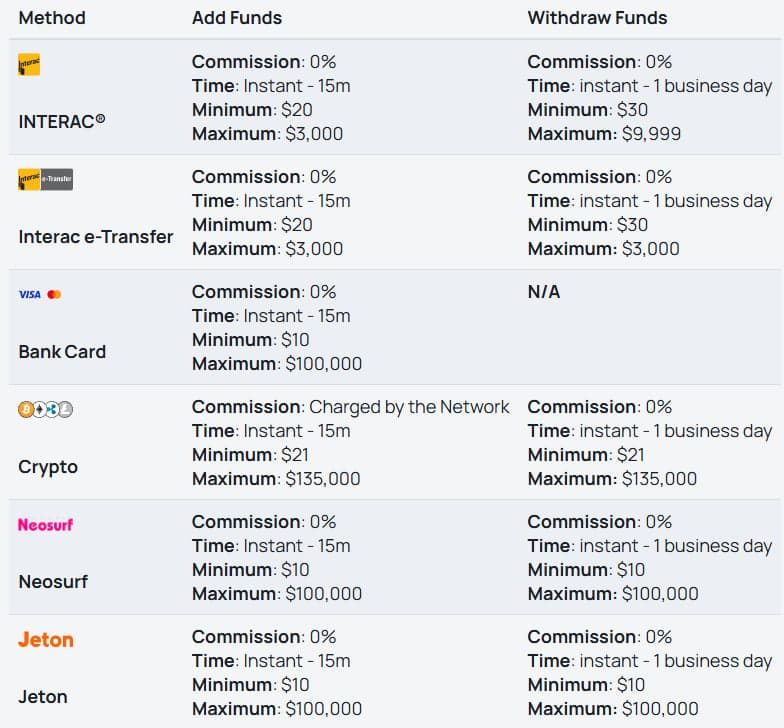
Banking is where offshore platforms reveal their priorities, and Battery Casino reveals plenty. Money enters through sixteen or so routes with no surcharge attached. Getting it back out narrows dramatically — half those rails work one way only, cards among them. Two clauses buried in the conditions matter more than any speed figure on the cashier screen, and neither gets mentioned in the marketing.
Everything below comes from published schedules and contract terms. Where numbers conflict, and several do, we show competing figures instead of picking whichever looks tidiest.
| Route | Floor | Ceiling | Speed | Operator Charge |
|---|---|---|---|---|
| 🏦 Interac e-Transfer | C$10 | C$3,000 | ⚡ Immediate | None |
| 🏦 Interac | C$20 per one schedule | C$9,999 | ⚡ Immediate | None |
| 💳 Visa | C$10 | C$7,000 | ⚡ Immediate | Nothing here; issuers vary |
| 💳 Mastercard | C$10 | C$7,000 | ⚡ Immediate | Nothing here; issuers vary |
| 🎟️ Neosurf | C$10 | C$10,000 | ⚡ Immediate | None |
| 💼 Jeton | C$10 | C$10,000 | ⚡ Immediate | None |
| 🟧 AstroPay | C$8 | C$14,300 | ⚡ Immediate | None |
| 🪙 CashtoCode | C$10 | C$1,500 | ⚡ Immediate | None |
| 🎫 eVoucher | C$5 | C$1,500 | ⚡ Immediate | None |
| 🔵 iDebit · instaDebit | Listed by two sources, absent from others | ⚡ Immediate | None | |
| ₿ Bitcoin | C$14 | C$20,000 | After confirmations | Chain fee only |
| 🔷 Ethereum | C$10 | C$20,000 | After block sealing | Gas only |
| Ł Litecoin | C$10 | C$20,000 | Rapid settlement | Chain fee only |
| 🐕 Dogecoin | C$10 | C$20,000 | Network-paced | Chain fee only |
| 🟢 Bitcoin Cash | C$10 | C$20,000 | Network-paced | Chain fee only |
| 🔺 Tron | C$10 | C$20,000 | Seconds-level | Minimal ledger cost |
| 💵 Tether (ERC-20 · TRC-20) | Per chain schedule | Depends on selected network | Gas or ledger cost | |
| 🔶 Ripple · Cardano · BNB | Listed among accepted coins; individual figures unpublished | Network-paced | Chain fee only | |
Interac dominates for obvious reasons — practically every adult here already banks through it, so a Batery account needs no new setup. Two floors circulate for that rail, C$10 against C$20, which almost certainly reflects the split between e-Transfer specifically and Interac more broadly, not a genuine error.
Nothing costs anything at the operator's end on incoming money. Your card issuer may disagree: banks here routinely classify offshore gambling merchants as high-risk or international, adding charges that surface on a statement instead of at checkout, and flat declines happen often enough to plan around. Coins avoid that entirely, which explains their prominence throughout Batery's cashier.
Four figures circulate across published material: C$9, C$10, C$20, and C$30. All four appear in print, none carries a caveat, and readers understandably conclude somebody is wrong.
Our reading resolves most of it. C$9 and C$10 describe absolute floors on cheap rails. C$20 belongs specifically to the wider Interac route. C$30 marks the qualifying threshold for stage one of the welcome ladder — an entirely separate question from whatever the cashier accepts. Since nobody states that distinction plainly, four numbers circulate where one sentence would settle matters. Practical upshot: C$10 opens the door, C$30 unlocks a promotion.
Canadian dollars price everything on this market's platform, with English and French both supported across the interface and live chat. Straightforward enough — until you consult certain independent directories, where the same brand appears listed in rupees and taka, with Bengali and Hindi as its interface languages.
Nothing sinister is happening. Battery Casino runs separate platforms per region, and one widely-read directory entry documents its South Asian build instead of ours. Confusion follows regardless, because that entry surfaces prominently when Canadians search the brand, showing bonus values denominated in currency they will never see and payment rails they cannot use. Anyone comparing offers should confirm which market a page describes before trusting its figures.
| Route | Floor | Ceiling | Typical Timing After Approval |
|---|---|---|---|
| 🏦 Interac e-Transfer | C$30 | C$10,000 | Frequently hours; occasionally the same afternoon |
| 🏦 Interac (wider rail) | Per schedule | C$9,999 | Around one working day |
| 🎟️ Neosurf | C$10 | C$100,000 | Roughly 24 hours |
| 💼 Jeton | C$10 | C$100,000 | Overnight in most cases |
| ₿ Coins (BTC · ETH · LTC · DOGE · BCH · TRX) | C$21 | C$135,000 | Quickest published option once verified |
| 💳 Visa · Mastercard | ❌ Unsupported for outgoing money | ||
| 🟧 AstroPay · CashtoCode · eVoucher | ❌ Incoming only | ||
Notice the asymmetry. Nine methods for filling an account collapse into four for emptying it, while that C$135,000 coin ceiling sits thirteen times above what Interac permits per transaction. Anybody expecting to build a sizeable balance should route through digital currency from day one, because switching later means verifying a fresh instrument all over again.
This deserves its own heading because plenty of Canadians assume symmetry, and the assumption costs them time. Fund via Visa or Mastercard and your payout must exit somewhere else — Interac e-Transfer, a voucher rail, or coins. AstroPay, CashtoCode plus eVoucher behave identically: happy to accept, unable to send.
Establishing your exit early is genuinely worth ten minutes. Discovering the restriction while a balance waits, then setting up an unfamiliar instrument, then verifying ownership of it, then waiting for review — that sequence turns a payout into a week. Choosing a two-way rail from the outset avoids all of it.
Highest floor among the coins at C$14, capped at C$20,000 incoming. Settlement waits on confirmations, so busy periods slow things down and network charges climb accordingly. Outbound, it shares the C$21 minimum and C$135,000 ceiling applying across every supported coin.
Each opens from C$10 with the same C$20,000 upper bound. Litecoin generally clears faster than Bitcoin at lower cost, which makes it a sensible default for regular movement. Gas pricing on Ethereum fluctuates unpredictably, and on smaller transfers those costs occasionally eat a noticeable slice — worth checking before confirming rather than afterwards.
Tron settles in seconds for negligible cost, and Tether riding that chain inherits both advantages, which explains why TRC-20 has become the default stablecoin route across offshore cashiers generally. Two versions exist here though: ERC-20 alongside TRC-20. Selecting one and sending the other creates a stuck transaction rather than a balance — a documented complaint involved exactly that mismatch, with funds credited only after manual intervention by staff. Read the network label twice.
All three appear among accepted assets on operator-side listings, though individual floors and ceilings go unpublished. Broader directory records add Solana, USD Coin and Binance Pay to the roster. Given the gaps, confirm inside the cashier before committing anything unusual.
Here sits the costliest line in the whole contract, and almost nobody quotes it. Whatever gets deposited must pass through play once in full before a payout instruction becomes valid. Submit one early and 10% plus C$10 comes off the amount.
Work through what that means. Put in C$500, decide against playing, request it back: you lose C$60. Nothing about that is hidden, since the terms spell it out; the clause simply lives far away from whichever screen you make the decision on. Anti-money-laundering rules explain why such clauses exist across the industry; the penalty structure here is nonetheless steeper than most, and we would rather flag it loudly than let you find out through a deduction.
Dodging it costs nothing: cycle the balance through a session, then withdraw. Staking C$500 at sensible sizing satisfies this comfortably.
Identity checks gate every debut payout, and the operator reserves a right to request them at any later point too. Three items get asked for:
| Document | Accepted Forms | Common Stumbling Block |
|---|---|---|
| Photo identification | Passport, driving permit, or national identity card | Expired credentials; corners cropped out of frame |
| Address confirmation | Recent hydro bill, banking statement, or letter from a public authority | Dated too long ago; name spelled differently from your account |
| Payment ownership | Capture of the banking interface or wallet you funded through | People forget this one exists until asked |
Published turnaround spans one to three working days on clean submissions. Documented cases stretch well past three weeks with an account frozen throughout, which is precisely why our advice never changes: handle this immediately after registering, long before any balance depends on it. Sending paperwork while winnings sit blocked converts routine administration into an anxious wait, and nothing about doing it early costs you anything.
Two related rules: masking your location through a VPN violates the agreement, and funding instruments must belong to you personally. Both trace back to identical compliance machinery, so working around either risks the account itself.
Published estimates look contradictory until separated by rail. Somebody quotes a single business day, elsewhere 72 hours appears, and a third figure spans up to three days. Each describes something different.
| Rail | Realistic Expectation | What Slows It |
|---|---|---|
| Coins | Fastest available once documents clear | Chain congestion; wrong network selected |
| Interac e-Transfer | Hours after approval, sometimes same afternoon | Internal approval queue rather than the rail itself |
| Jeton · Neosurf | Overnight typically | Wallet-side processing |
| Anything bank-routed | Toward the upper bound of published windows | Traditional settlement timetables |
| First payout ever | Add verification time on top | Document review, one to three working days |
Three Batery limits interact, and their shape is unusual. C$50,000 caps any 24-hour period across the account. Individual coin transactions reach C$135,000 — above the daily figure, which therefore governs whichever rail you pick. Winnings themselves carry no published ceiling according to directory records.
Contract terms nonetheless permit anything above roughly €10,000 to be released across monthly instalments. Read that beside the previous paragraph: nothing limits what you might win, yet an explicit mechanism exists for paying big sums in stages. Both statements coexist, and the second one matters far more if you ever hit something substantial.
One documented case sharpens the point. A player in Alberta reported that after a significant win, their permitted payout dropped to C$1,000 per 24 hours — a fraction of the headline C$50,000. Whether that reflected policy, a security review, or something else, we cannot say from outside, and the operator's side of it is not public. What the case demonstrates: published ceilings describe a maximum permitted, not an amount you will necessarily receive. Anyone sitting on serious winnings should read C$50,000 as an upper theoretical bound, never a promise.
| Event | Cost | Who Charges |
|---|---|---|
| Funding by any fiat rail | Nothing | — |
| Funding by card | Possible handling charge | Your issuing bank, not this cashier |
| Funding or cashing out by coin | Network cost only | The blockchain itself |
| Standard payout | Nothing published | — |
| Payout before deposit turnover | 10% plus C$10 | Operator, per contract terms |
Batery's cashier settings double as safer-play instruments, and deploying them deliberately beats leaving that function as an afterthought. Funding ceilings configure by day, week or month from inside your profile, capping what can reach the account regardless of intention in the moment. Loss thresholds work similarly. Session timers cut off before time disappears unnoticed.
Beyond those, timed breaks run 24 hours, two days, a week, or a month, while a lock extends from thirty days out to five years or with no end date attached. Everything activates without contacting support, which matters because the impulse to stop rarely arrives during business hours.
Worth being direct about the arithmetic: house margins mean sustained play costs money over time, whatever any individual title returns. Deposits are entertainment spending, not investment. If chasing losses, hiding activity, or dipping into money meant for rent starts happening, those are signals rather than bad luck. Free confidential help exists countrywide — ConnexOntario serves that province, equivalent services run through every provincial health authority, Gamblers Anonymous holds meetings nationally, and Gambling Therapy operates online. Note too that because authorisation here sits offshore, provincial exclusion registers cannot enforce against this brand, so set the internal lock separately if that matters to you.
Depends what you are asking. Cashier floors start near C$9 or C$10 across most rails, with eVoucher dipping to C$5 and AstroPay to C$8. Interac carries C$20 in one published schedule. Claiming the opening welcome stage, though, demands C$30 — a wholly separate threshold, and precisely why four different minimums circulate in reviews.
Both card schemes function for incoming money exclusively here. Vouchers and AstroPay share that limitation. Your exit runs through Interac e-Transfer, Neosurf, Jeton, or a supported coin. Arranging it in advance saves considerable frustration, since any fresh instrument requires its own ownership check.
Digital currency, once verification has cleared. Interac follows closely and frequently lands within hours of internal approval. Wallets such as Jeton generally finish overnight. Anything travelling through conventional banking sits at the slow end. Quoted windows spanning a day, three days, or somewhere between describe these separate rails instead of disagreeing with one another.
Consequence of requesting a payout before whatever you deposited has been staked fully. Contract terms demand that turnover, and bypassing them triggers the deduction. Nothing conceals this rule, though its placement guarantees people miss it. Cycling funds through normal play first sidesteps everything.
Not at its own end, across any rail we could identify. Coins carry network costs, which go to the blockchain rather than the operator. Canadian issuers frequently add handling charges for offshore gambling operators, or decline the transaction outright — that cost appears on your statement, and the casino has no part in it.
C$50,000 governs each 24-hour window. Single coin transfers technically reach C$135,000, yet the 24-hour bound still holds. No ceiling exists on winnings; terms nevertheless allow anything past roughly €10,000 to arrive in monthly instalments, and one documented complaint describes a permitted amount dropping to C$1,000 per day after a substantial win. Treat headline figures as theoretical maximums.
Three. Government photo identification — passport, driving permit, or national card. Something recent showing where you live: hydro bill, banking statement, or correspondence from a public authority. Lastly, an image of whichever payment interface you funded through, proving it belongs to you. Tidy submissions clear within about 72 working hours, though documented checks have run considerably longer.
No — that breaks the contract. Where you sit drives licensing compliance and promotional eligibility alike, so disguising it endangers the account instead of solving anything. Funding methods must additionally be registered under your own name.
Tether appears on two chains here, ERC-20 and TRC-20. Tron-based transfers settle in seconds at negligible cost, making TRC-20 the practical default. Whichever you choose, confirm the label matches on both ends before sending — a documented case involved precisely this mismatch, resolved only after staff intervened manually.
None appeared on Canadian-facing schedules during our review. Certain directory records list Google Pay alongside rails including UPI, Paytm and bKash, but those belong to the brand's South Asian platform rather than this one. Available here: Interac in both forms, cards inbound, Neosurf, Jeton, AstroPay, CashtoCode, eVoucher, iDebit and instaDebit on some listings, plus roughly ten coins. Our full Batery review covers how those rails interact with bonus terms.